
From Software Engineer to AI Engineer in 2026: A Practical Roadmap
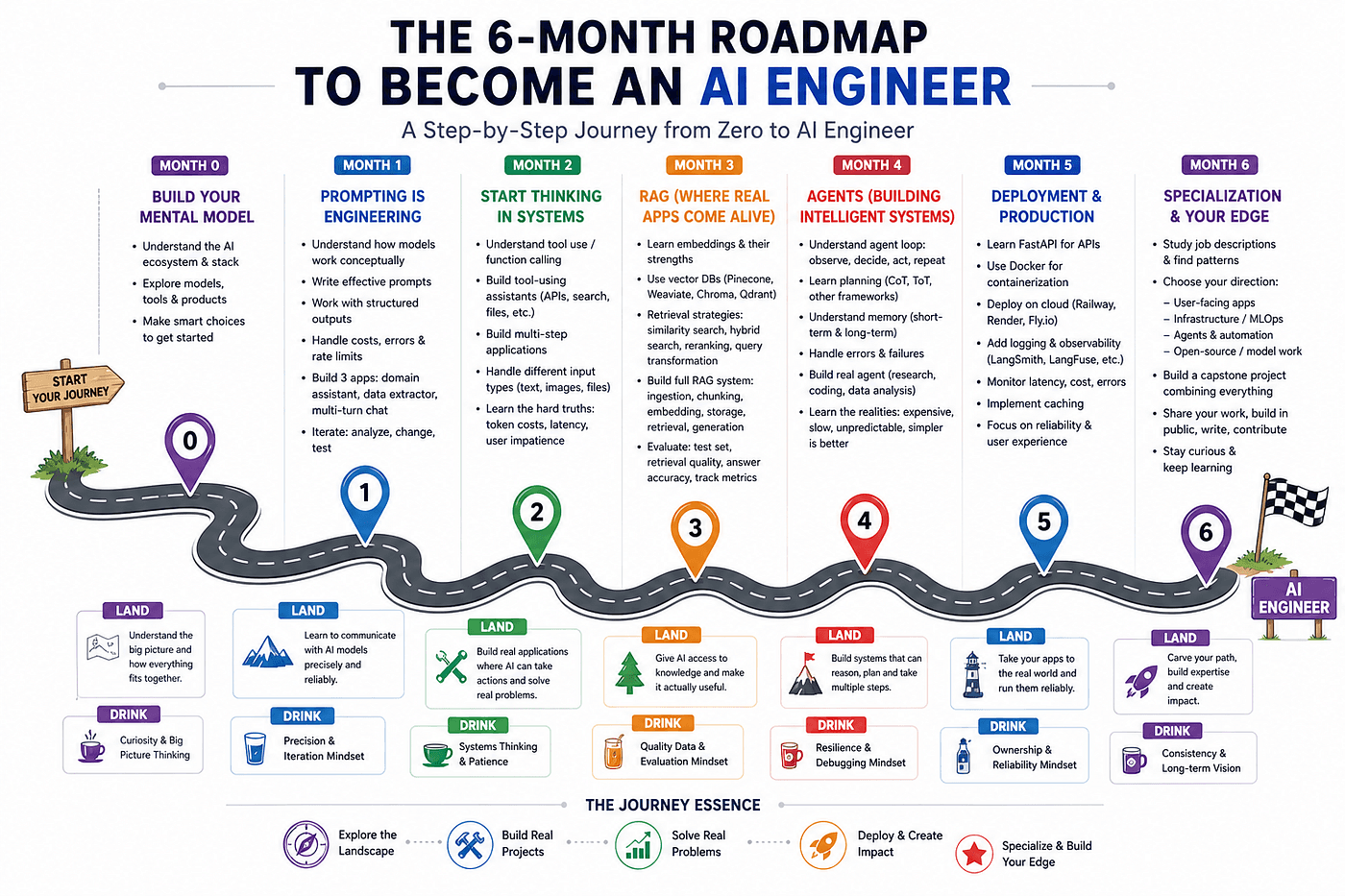
A practical guide to moving into AI engineering in 2026: build on your software skills, learn model integration and evaluation, and ship a reliable AI feature in 90 days.
Software engineers considering AI in 2026 don’t need to start their careers over. The strongest transition usually builds on what they already know: designing systems, working with data, testing failure cases, and shipping software people can trust.
What changes is that a model becomes one part of the system. An AI feature still needs clear requirements, useful context, reliable interfaces, evaluation, security, and monitoring. Prompting matters, but it is only one layer.
What AI engineering means
The title varies across companies. An AI engineer might connect a model to a product, build a search and retrieval workflow over company documents, create an internal assistant, or operate a multi-step process that combines models with conventional software.
The shared work is making model behavior useful and dependable. That means choosing where a model belongs, providing relevant data, measuring output quality, handling uncertainty and failures, and deciding what the system should do when it cannot answer well.
Start with the skills you already have
Backend engineering: APIs, service boundaries, retries, timeouts, and queues help you integrate model calls safely.
Database experience: data modeling, search, access control, and freshness matter when an application retrieves context.
Testing and quality: representative examples and regression checks help reveal when a prompt, model, or data change makes results worse.
Security and operations: logging, permissions, privacy, latency, and cost remain engineering concerns.
Product thinking: knowing when AI solves a real user problem is as important as knowing how to call a model API.
Anthropic’s December 2025 study of its own engineers and researchers describes AI assistance being used for debugging, codebase understanding, feature work, and learning across unfamiliar areas. It also reports concerns about losing practice with some skills. The findings are specific to one organization, but the lesson is useful: AI can expand what an engineer takes on, while engineers still need the judgment to review and own the result. Read the study.
A practical 90-day transition
Days 1–14: Learn model behavior
Build a small application that calls a model through an API. Try clear, ambiguous, and adversarial inputs. Track where the model is useful, where it invents details, and where a conventional rule or database query would be more reliable. Learn the basics of structured outputs, tool calls, token limits, and latency.
Days 15–35: Add useful context
Give the application access to a limited set of documents or records. Retrieve relevant material for each request, preserve existing permissions, and handle missing or conflicting information explicitly. Start with the simplest design that fits the data rather than adding infrastructure for its own sake.
Days 36–60: Evaluate the feature
Create a set of realistic examples based on the task. Define what a good answer looks like, then check correctness, completeness, grounding, safety, and response time. Run those examples when you change the model, prompt, retrieval logic, or source data. A polished demo is not evidence that a feature works reliably.
Days 61–90: Operate and explain it
Add production safeguards: handle timeouts and malformed responses, provide a sensible fallback, monitor latency and cost, and collect user feedback. Avoid logging sensitive prompts or personal data without a clear need and protection. Write a short case study that explains the user problem, architecture, evaluation results, tradeoffs, and what you would improve next.
Build judgment, not just prompts
Good AI engineering is a systems discipline. A prompt can guide behavior, but it cannot guarantee correctness or replace sound data design, evaluation, and failure handling. Ask: What evidence should the model use? How will I notice a bad result? What should happen when the model is uncertain? Can a simpler approach solve this more predictably?
Keep your fundamentals sharp by reading generated code, tracing data flows, reviewing edge cases, and occasionally solving problems without delegation. As AI makes implementation faster, the ability to define the right problem and verify the result becomes more valuable.
Your next step
Pick one repetitive task in a product or workflow you understand. Build the smallest AI feature that could help, create a set of examples to evaluate it, and measure whether it improves the user’s experience. That project will teach you more than collecting tools or trying to learn every model technique at once.
The move from software engineer to AI engineer is a progression: apply strong engineering habits to systems that include models. Learn enough about model behavior to make good choices, build around real constraints, and take responsibility for what reaches users.
Further reading
Stay in the loop
Get notified when new posts are published. No spam, unsubscribe anytime.
No spam · Unsubscribe anytime